
Most sellers I speak to believe they will know when the time is right. In practice, the ceiling does not announce itself — it shows up quietly in slower transactions, shrinking buyer pools, and a final sale price that barely covers the cost of waiting. If you are thinking about when to sell your Singapore condo, here is how to read the signals before the market reads them for you.
Why Every Property Has Its Own Ceiling
Singapore's property market is often reported as a single story — prices up, demand strong, sentiment positive. But the market does not move as one block. Each development, each stack, each floor level has its own price trajectory shaped by facing, age, recent transaction history, and the specific buyer profile that unit attracts. What is true for a high-floor pool-facing unit in your development may not be true for your mid-floor unit on the west-facing stack. Grouping them together is one of the most common mistakes sellers make when timing an exit.
This matters most for sellers considering HDB upgrading in 2026, where the sequence of selling and buying has real financial consequences. If your condo resale value has plateaued while replacement costs for a larger unit or landed home continue to climb, waiting does not work in your favour. The gap between what you net and what you need to spend can quietly widen — and that is a cost that rarely shows up in headline price data.
Two Signals That Tell You the Ceiling Is Forming
The first signal is how long comparable units are sitting on the market. A year ago, a well-priced resale condo in a mid-tier Singapore development might have transacted within two to three weeks of listing. If similar units in your project are now taking six, eight, or ten weeks to close, that is a meaningful slowdown — not just noise. Pull the URA transaction data for your development. If the last four or five transactions are priced within one to two percent of each other across different months, price discovery has effectively stopped. The market has found a ceiling for that unit type, and sellers who price above it are simply sitting.
The second signal is about who can actually buy your unit at your target price. ABSD rates, TDSR limits, and LTV rules have reshaped the buyer pool considerably over the past few years. Once a condo crosses the 1.5 million dollar mark, the number of eligible local buyers narrows — permanent residents face higher ABSD, and HDB upgraders are constrained by their Minimum Occupation Period timing, CPF balances, and what their existing flat can realistically net them. If your target price sits at the edge of what most buyers in your segment can finance, demand does not disappear overnight. It thins out gradually, and you start seeing more viewings that do not convert into offers.
The Real Cost of Waiting One Year Too Long
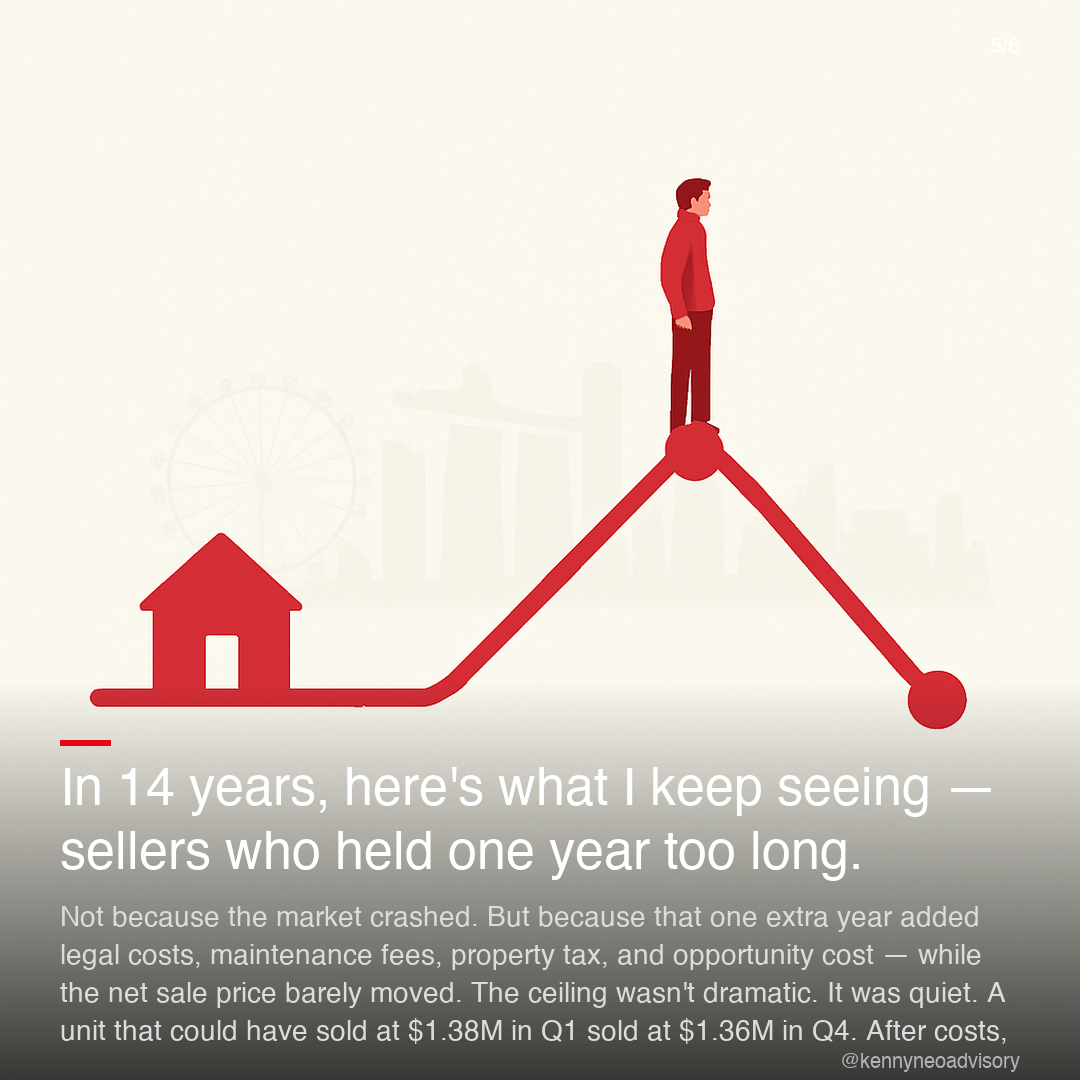
In over 14 years of advising sellers across Singapore, the situation I encounter most often is not a dramatic market correction. It is the seller who held on through a flat period and absorbed a year of costs — maintenance fees, property tax, mortgage interest if applicable, and the legal and agent fees that apply whenever the eventual sale does happen. Individually, each cost seems manageable. Added together across twelve months, they can represent 20,000 to 40,000 dollars or more depending on the unit, before a single dollar of price movement is even factored in.
A unit that could have transacted at 1.38 million dollars in the first quarter may close at 1.36 million in the fourth quarter of the same year. After accounting for holding costs, the seller has not held steady — they have lost ground in real terms. The ceiling was not dramatic. It was quiet. This is why knowing your exit math matters more than watching the market headlines. Calculate your net sale proceeds at your current target price, subtract your outstanding costs to carry the property for another six to twelve months, and compare that against what a realistic transaction looks like today. That comparison will tell you more than any market report.
How to Check If Your Unit Still Has Room to Run
Start with the URA Realis database or the HDB resale portal if your exit involves a private property purchase funded partly by proceeds from an HDB sale. Filter transactions to your specific development and unit type — not the project as a whole. Look at the last six to eight transactions and note whether prices are still stepping up meaningfully between each sale, or whether they have begun to cluster within a narrow band. A stepping pattern suggests there is still upward momentum. Clustering suggests the market has found its level.
Beyond the data, ask yourself whether your original reason for buying this unit still maps to the buyer who would purchase it today. If you bought in 2018 as an investment property anticipating capital appreciation, and that appreciation has largely materialised, the question becomes whether there is a credible case for another meaningful move upward — or whether the remaining upside is marginal relative to the cost and risk of staying in. For those navigating when to sell Singapore condo in 2026 and move into the next stage of their property journey, an honest answer to that question is worth more than optimism about headlines.
If you are unsure whether your unit still has room to grow or has already found its ceiling, I am happy to take a look at the recent transaction data with you and give you a straight read. Send me a DM on Instagram at @kennyneoadvisory or reach out via WhatsApp — no pressure, just an honest conversation about where your property actually stands.