
There is no secret trick that makes Additional Buyer's Stamp Duty disappear, but there are six legal routes that can reduce it to zero or close to it, and every one of them works on the same principle: your ABSD rate depends on how many residential properties you own at the moment you buy. The routes are decoupling a jointly owned private property so one spouse buys again as a first-time buyer; holding your first property under one name from the start; buying in an adult child's name once they are 21; selling your existing home before you buy the next one; buying through a trust, which carries a 65 per cent ABSD (Trust) charge upfront with only conditional remission; and, for eligible HDB households, the new executive condominium route. Each has real costs and real failure modes, and the right one depends entirely on your household's numbers. I walk through all six below, with the honest arithmetic. For the current ABSD rates, remission rules and worked upgrader examples, see my complete guide to ABSD in Singapore.

Route 1: Decoupling — one spouse transfers their share to the other
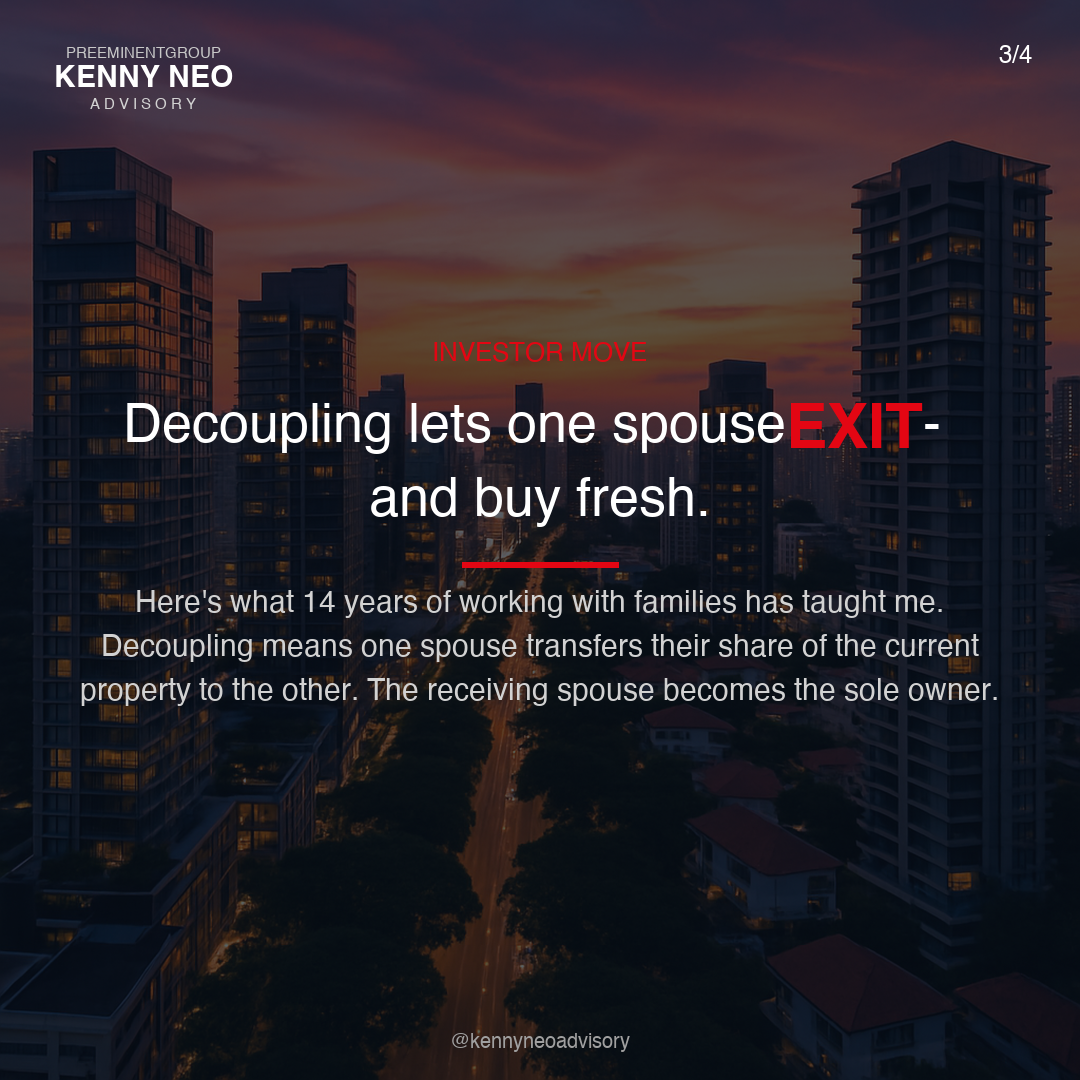
Decoupling suits couples who already own a private property jointly and want to buy a second one without the 20 per cent ABSD a Singapore Citizen pays on a second purchase. One spouse transfers their share of the current home to the other, at market value. After completion, one spouse owns the property outright, and the exiting spouse holds zero residential property — so their next purchase, in their sole name, is taxed as a first property at 0 per cent ABSD for citizens.
The sequence is everything. The decoupling must complete before the second purchase is committed; once you exercise an option while still a joint owner, the ABSD liability is locked in and cannot be unwound. And the transfer is a genuine transaction with genuine costs: Buyer's Stamp Duty on the market value of the share transferred (tiered from 1 to 6 per cent), legal fees for two sets of lawyers because each party needs separate representation (commonly $5,500 to $7,000 combined), a formal valuation, and refinancing of the existing loan into the remaining owner's sole name. If the property is still inside its Seller's Stamp Duty holding period, SSD applies to the share sold as well. Any CPF the exiting spouse used must be refunded to their CPF account with accrued interest on completion.
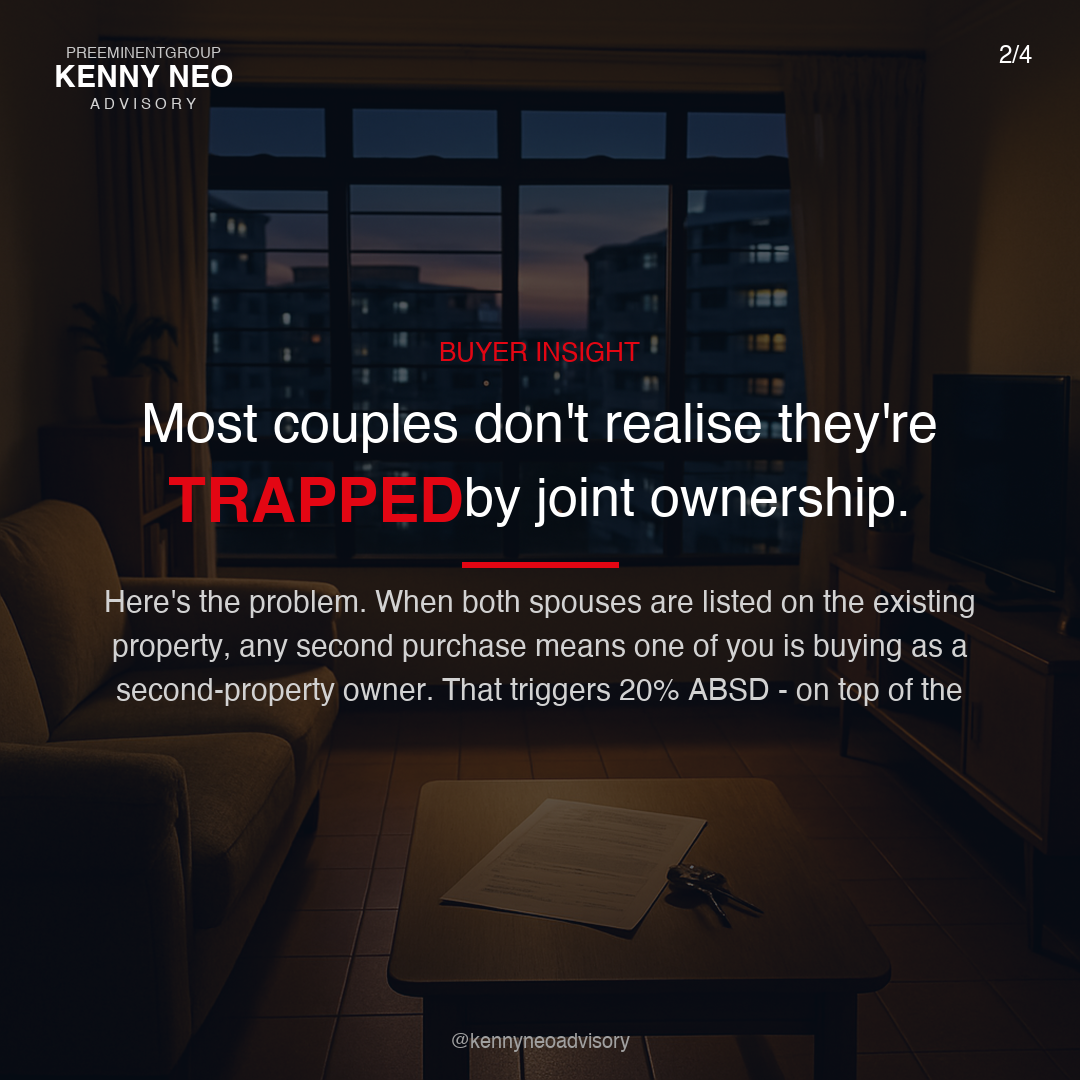
Here is the honest framing. On a $2 million condo, a half-share transfer attracts roughly $24,600 in BSD, and the all-in friction usually lands around $30,000 to $35,000. Against $300,000 of ABSD on a $1.5 million second purchase, that is a straightforward trade. But on a lower-value home with a modest intended second purchase, the friction can eat a large slice of the saving — and if the remaining spouse cannot pass the bank's Total Debt Servicing Ratio assessment carrying the full loan alone, the decoupling cannot proceed at all. One more hard boundary: HDB flats generally cannot be decoupled between spouses. HDB closed that avenue in 2016 except in special circumstances such as divorce or financial hardship, so this route is for private property owners.
Route 2: Buying under one name from the start
The cheapest decoupling is the one you never need. Couples who plan a two-property household early can buy the first home in one spouse's sole name, leaving the other spouse's first-property status intact for the future purchase. There is no transfer, no second round of BSD, no dual legal fees — the structure costs nothing beyond forgoing the convenience of two names on the title.
The constraint is financing. A sole owner qualifies for the loan on their income alone, so this works when one spouse's income can carry the first property comfortably under TDSR. It also requires genuine commitment: the non-owning spouse has no legal interest in the home, which matters in estate planning and, frankly, in a divorce. And this is exactly where the 99-to-1 temptation appears — buying in one name, then transferring a token 1 per cent so the second spouse can prop up the loan without paying their full ABSD. Do not do this. IRAS treats 99-to-1 arrangements structured to evade ABSD as tax avoidance and has been actively auditing them since 2023, with clawback plus a 50 per cent surcharge. If both incomes are needed for the loan, one-name ownership is simply not your route.
Route 3: Buying in an adult child's name (21 and above)
Parents who already own property sometimes fund a purchase in the name of a child aged 21 or over. If the child is a Singapore Citizen with no residential property, the purchase attracts 0 per cent ABSD, because the buyer on the title is genuinely a first-time buyer. For this to be legitimate, the money must be a genuine gift and the child must genuinely own the property — legally and beneficially. If the child merely holds the property on an undisclosed trust for the parents, the arrangement is not a gift at all, and stamp duty follows the true beneficial owner.
The costs are less about fees and more about consequences. The property belongs to your child: it is exposed to their future divorce or creditors, and you cannot take it back. The child loses first-timer status for BTO flats, executive condominiums and CPF housing grants — often worth a great deal to a young Singaporean. If a mortgage is needed, it is assessed on the child's income, not yours, so many of these purchases end up largely cash-funded. This route fits families with the liquidity to make an outright gift and children whose own housing plans would not be damaged by it. It fits nobody as a disguised holding structure.
Route 4: Selling first, then buying again
The route with the least structure is timing. Once the sale of your existing home has legally completed, you own zero residential property, and your next purchase is a first property — 0 per cent ABSD for a citizen, 5 per cent for a PR. No transfer, no trust, no restructuring; just sequence.
The cost is the gap between homes. You may need to rent for six to twelve months, move twice, and accept the risk that the market moves while you are out of it. For married couples with at least one Singapore Citizen spouse, there is a middle path: buy the replacement home first, pay the ABSD upfront, and claim a full refund provided the existing home is sold within six months (of the purchase for a completed property, or of TOP for one under construction) and both spouses are on the new title. The refund is real money back — but the deadline is absolute, and I have seen a collapsed buyer at the eleventh hour cost a family a six-figure refund. If you buy first, your exit must already be lined up, not hoped for.
Route 5: Trusts — 65 per cent upfront, remission only with strings attached
Buying a residential property in trust for a beneficiary — typically a minor child — triggers ABSD (Trust) at 65 per cent, payable within 14 days, and the entire purchase must be in cash because trust purchases cannot be mortgaged. A refund of the difference between 65 per cent and the beneficiary's own ABSD rate can be applied for within six months, but only if the trust names an identifiable individual beneficiary whose beneficial ownership is vested unconditionally and irrevocably. Discretionary trusts, revocable trusts, and trusts with contingent beneficiaries do not qualify — the 65 per cent stays paid.
Read that again before anyone sells you a trust as an ABSD play: you front the full price in cash plus 65 per cent ABSD, and remission is conditional, not automatic. Where trusts genuinely earn their place is legacy planning — parents who want a specific property vested in a specific child, with the tax treatment a consequence rather than the objective. If your goal is simply a second investment property, this is almost never your route.
Route 6: The executive condominium route
For eligible HDB households, a new executive condominium bought from a developer is the one way to commit to a private-titled property while still owning your flat, without ABSD changing hands. Because new ECs are sold under HDB eligibility rules, buyers do not pay ABSD upfront; instead, the household undertakes to dispose of its existing flat within six months of the EC receiving its Temporary Occupation Permit.
The gates are real: a qualifying family nucleus with at least one Singapore Citizen (and the other a citizen or PR), a household income ceiling of $16,000 a month, and no private property ownership within the preceding 30 months. Second-timer households also pay a resale levy on qualifying new EC purchases. So this is not a portfolio-building tool — it is a clean upgrade path for HDB families who would otherwise face the sell-first gap or the remission deadline. If your household qualifies, it deserves a place on your shortlist before any of the structural routes above.
The six routes side by side
| Route | Who it suits | Typical friction cost | Key risk |
|---|---|---|---|
| Decoupling | Couples jointly owning a private property, one strong income | BSD on the share + ~$5,500–$7,000 legal + valuation + refinancing (~$30k–$35k on a $2m home) | Remaining spouse fails TDSR alone; friction outweighs savings on lower-value homes; not for HDB |
| One name from the start | Couples planning early, one income carries the first loan | Near zero — structure only | Loan qualifies on one income; non-owner has no legal interest |
| Adult child's name (21+) | Families with cash for a genuine gift | Largely cash-funded; standard BSD | Property is irrevocably the child's; child loses BTO/EC first-timer benefits |
| Sell first, then buy | Upgraders replacing one home with another | Interim rental + two moves (or fund ABSD upfront under spousal remission) | Market moves while you are out; remission deadline is absolute if buying first |
| Trust purchase | Legacy planning for a named individual beneficiary | Full cash purchase + 65% ABSD (Trust) upfront | Remission is conditional — non-qualifying trusts keep the 65% cost |
| New EC purchase | Eligible HDB households under the $16,000 income ceiling | Resale levy for second-timers; must sell flat within 6 months of TOP | Strict eligibility gates; disposal undertaking is binding |
Common questions
Is decoupling still legal in Singapore?
Yes. Decoupling — one co-owner transferring their share of a private property to the other at market value, with Buyer's Stamp Duty paid on the share — remains a legal and recognised transaction. What IRAS pursues are artificial arrangements structured purely to avoid stamp duty, such as contrived 99-to-1 purchases. A genuine transfer, properly valued, documented and paid for, is a different thing entirely. Note that HDB flats generally cannot be decoupled between spouses; that avenue closed in 2016 except in special circumstances.
How much does decoupling cost?
Plan for Buyer's Stamp Duty on the market value of the share transferred (tiered from 1 to 6 per cent), legal fees for two sets of lawyers (commonly $5,500 to $7,000 in total), a valuation report, and any costs of refinancing the remaining owner's loan. If the transfer falls within the Seller's Stamp Duty holding period, SSD applies as well. On a $2 million home, a half-share transfer typically lands around $30,000 to $35,000 all in — modest against a six-figure ABSD bill on the next purchase, but material if the intended purchase is small.
Can I avoid ABSD with a trust?
Not in the way most people hope. Buying residential property in trust attracts ABSD (Trust) at 65 per cent, payable upfront and in full cash, because trust purchases cannot be mortgaged. A refund down to the beneficiary's own ABSD rate is available only where the trust names an identifiable individual beneficiary whose beneficial ownership is vested unconditionally and irrevocably. A trust is a legacy-planning instrument that happens to interact with ABSD — it is not an ABSD shortcut.
Does selling first avoid ABSD?
Yes. Once the sale of your existing home has been legally completed, you hold no residential property, and your next purchase is taxed as a first property — 0 per cent ABSD for Singapore Citizens. The trade-off is the gap between homes: you may need to rent or stay with family between completion dates. Married couples with at least one Singapore Citizen spouse can do it in the other order — buy first, pay the ABSD, and claim a full refund if the old home is sold within six months — but the deadline is unforgiving.
Can Singapore PRs avoid ABSD?
Not on the first purchase — Singapore Permanent Residents pay 5 per cent ABSD on their first residential property, and no structure removes it. What PR households can plan around is the jump to 30 per cent on the second property, using the same routes as citizens: holding the first property under one name, decoupling, or selling before buying again. A married couple where one spouse is a Singapore Citizen and the other is a PR can also apply for remission so their first matrimonial home is taxed at citizen rates.
Are 99-to-1 arrangements a way to avoid ABSD?
Treat them as a warning, not an option. IRAS actively pursues 99-to-1 arrangements structured to evade ABSD — typically where a buyer purchases in one name and then transfers a 1 per cent share to a co-owner so the co-owner can support the loan without triggering their full ABSD rate. IRAS has audited these arrangements since 2023, claws back the ABSD avoided, and imposes a 50 per cent surcharge on top. Every route on this page involves a genuine change of ownership with full stamp duty paid on what changes hands — that is the line between planning and avoidance.

What I have seen over 15 years of structuring these decisions is simple: families who map the route before they fall in love with a unit keep more of their money than families who structure after the fact. The right route for your household depends on incomes, CPF positions, holding periods and what you actually want the second property to do — and that takes one honest conversation, not a spreadsheet of tricks. If you are weighing decoupling against selling first, or wondering whether your household even needs a structure at all, drop me a WhatsApp message and we will work through your numbers properly. This article is general information, not tax or legal advice — confirm your exact stamp duty position with IRAS and your conveyancing lawyer before committing.